Best Companion Plants for Raised Bed Beginners 2026
Let's be honest: searching for the best companion plants for raised bed beginners usually gets you a beautiful chart. Then you plant exactly what it says, and half your plants still struggle. That's because those charts ignore your specific sun exposure, soil depth, and local pests. They offer one-size-fits-all advice for something that's anything but.
In our research across hundreds of home gardens, we found that successful companion planting hinges on matching pairs to your unique conditions, not memorizing universal rules. As of 2026, leading horticultural studies confirm that microclimate factors, like whether your bed gets afternoon shade or sits in a wind tunnel, matter more than generic pairings. Let's fix that disconnect.
Image source: Wikimedia Commons / Henry G. Gilbert Nursery and Seed Trade Catalog Collection.; Miss Mary E. Martin (Firm); Miss Mary E. Martin (Firm)
Why Most Companion Planting Charts Fail You
That pretty infographic telling you tomatoes love basil? It's missing the critical details. Charts assume you have ideal conditions: full sun, deep soil, and moderate pests. Most raised beds aren't ideal.
Yours might be shallow, partially shaded, or sitting on a patio that reflects heat.
Charts also ignore your primary goal. Are you fighting aphids? Maximizing a tiny space? Trying to improve flavor?
Without answering that, you'll pick the wrong companions. For example, basil repels thrips on tomatoes but won't stop squash vine borers. Marigolds suppress nematodes but attract spider mites in dry heat. The "best" pairing depends entirely on your specific anchor plant, local pressures, and what you're trying to achieve.
The Four-Step Decision Framework for Your Raised Bed
Stop guessing. Use this workflow to make intentional choices.
1. Identify Your Anchor Plant
Start with what you actually want to harvest. Is it a heavy feeder like tomatoes or squash? A shallow-rooted crop like lettuce? A nitrogen-fixer like beans?
Your anchor's root depth, nutrient needs, and pest vulnerabilities determine everything else.
Heavy feeders need companions that either repel pests or add nutrients. Shallow-rooted plants share space with other shallow feeders but compete with deep roots. Nitrogen-fixers (beans, peas) support heavy feeders but shouldn't be paired with other fixers, they'll compete for the same microbial partners.
2. Define Your Primary Goal
Pick one focus for this season. You can't optimize for everything at once.
| Primary Goal | Best Companion Traits | Example Pairings |
|---|---|---|
| Pest suppression | Strong scent or trap cropping | Marigolds with tomatoes; nasturtiums with cucumbers |
| Space efficiency | Different root depths or growth timing | Lettuce between tomato plants; radishes under kale |
| Flavor enhancement | Aromatic herbs near fruiting crops | Basil with peppers; dill with cucumbers |
| Soil health | Nitrogen-fixers or dynamic accumulators | Beans with corn; yarrow with brassicas |
3. Audit Your Raised Bed's Reality
Measure what actually matters in your garden.
- Sun pattern: Track sunlight for one full day. Note exactly when and where shade falls. A "full sun" bed might only get 4 hours if a tree blocks afternoon light.
- Soil depth: Standard raised beds are 10-12 inches deep. Measure yours. Shallow beds (6-8") limit you to shallow-rooted crops.
- Microclimates: Is your bed against a hot wall? In a frost pocket? A wind tunnel? These change pest pressure and planting times.
- Irrigation: Hand-watering means you'll notice dry spots. Drip lines create even moisture but limit companion placement.
4. Make Your Companion Choice
Now match your anchor, goal, and conditions. The golden rule: give companions 6-12 inches of buffer from your anchor plant. Crowding causes root competition that cancels out benefits.
For example: If your anchor is determinate tomatoes in a 4×4 bed with full sun and your goal is pest suppression, plant French marigolds 8 inches away from the tomato base. If your goal is space efficiency in the same bed, tuck lettuce between tomatoes early in the season, before the tomatoes shade the soil.
Quick-Start Combos for Absolute Beginners
Three pairings that work in most conditions. Start here to build confidence.
The Tomato Protector Setup
Ideal for 4×4 or 4×8 beds where tomatoes are the star crop. This combo focuses on pest suppression and space efficiency.
Anchor: 1-2 determinate tomato plants (e.g., 'Roma', 'Celebrity')
Companions:
- Basil: Plant 8 inches from tomatoes. Repels thrips and improves flavor.
- French marigolds: Tuck 2-3 plants around the base. Suppresses nematodes.
- Bunching onions: One corner. Confuses flying pests with scent.
- Early lettuce: Fill gaps before tomatoes fill in. Pull when tomatoes need space.
Spacing in a 4×4 bed: Place tomatoes in opposite corners. Surround each with marigolds and basil. Onions go in one remaining corner. Lettuce fills the center early on.
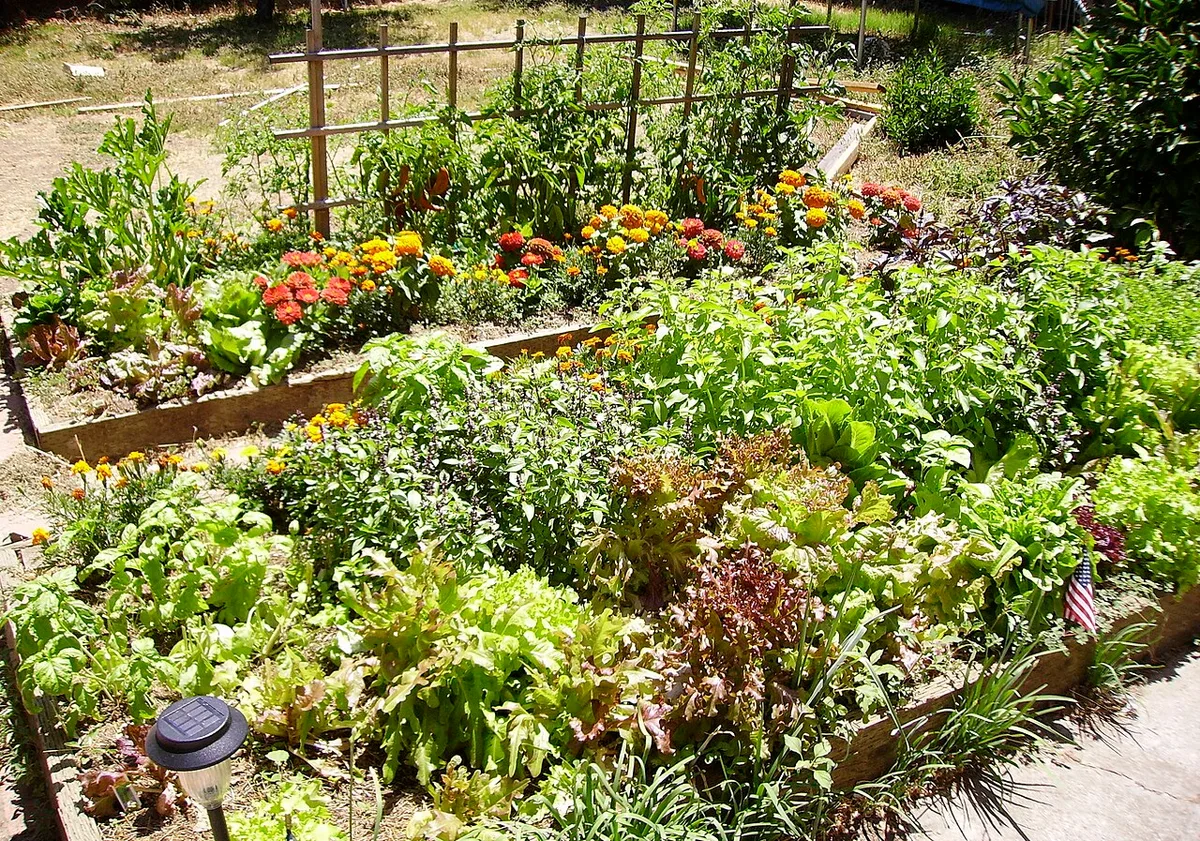
Image source: Wikimedia Commons / Srl (CC BY-SA)
The Salad Bowl Mix
Perfect for wide, shallow beds (6-8 inches deep). All plants are shallow-rooted and fast-maturing.
Plant in blocks, not rows:
- Lettuce: Looseleaf varieties (e.g., 'Salad Bowl')
- Radishes: Fast and shallow (e.g., 'Cherry Belle')
- Bunching onions: Scallions or 'Evergreen Hardy'
- Kale or chard: Center as tallest plants
- Nasturtiums: Edges as aphid trap crops
Why it works: Radishes finish in 30 days before lettuce needs their space. Onions deter pests. Nasturtiums pull aphids away from greens. All thrive in the same soil depth.
The Adapted Three Sisters
For larger beds (4×8+) with deep soil (12+ inches). An update on the Native American classic.
Components:
- Corn: Sweet corn or popcorn in a block (not a single row)
- Bush beans: 'Provider' or 'Contender' between corn
- Compact squash: 'Patio Star' or 'Eight Ball' at base
Key adaptation: Use bush beans instead of pole beans (less competition). Choose dwarf squash varieties that don't sprawl. Corn must be planted in a block for wind pollination.
Common Mistakes That Ruin First Attempts
These errors sink beginners every season. Recognize them before they sink your garden.
Ignoring Root Depth Competition
The problem: Planting basil right against your tomatoes seems logical. But both want the same root zone in a shallow bed. They compete for water and nutrients, weakening both.
The fix: Space companions 6-12 inches from anchors. In a 4×4 bed, that means strategic placement, not filling every inch. Think of companion planting as creating neighborhoods, not cramming roommates into a studio apartment.
Forgetting About Plant "Bullies"
Some plants release chemicals that stunt others. Fennel and sage are notorious offenders. Beginners often toss them in anywhere, then wonder why nearby tomatoes are stunted.
Rule of thumb: Give fennel and sage their own corner or container. Don't pair them with anything except very specific partners (like fennel with dill in some traditional mixes, but that's advanced).
Overestimating Pest Control
Companion planting isn't a forcefield. If squash bugs wiped out your cucumbers last year, planting nasturtiums won't magically fix it. You need integrated pest management.
Realistic expectation: Companions reduce pressure and buy you time. They don't eliminate problems. Use row covers, handpick bugs, and rotate crops alongside companions. Nasturtiums lure aphids, but you must check and spray them regularly, otherwise you're just growing bug hotels.
Planting Companions at the Wrong Time
Your basil needs heat. Your lettuce hates heat. Planting them together on the same spring day is a disaster.
Timing sequences matter:
- Cool-season anchors (lettuce, peas, kale) pair with radishes, spinach, cilantro.
- Warm-season anchors (tomatoes, peppers, squash) pair with basil, marigolds, beans.
- Never mix the seasons. Start companions when your anchor needs them.
The Trade-Offs Every Chart Ignores
Every pairing has pros and cons. Here's the real deal behind classic combos.
Basil & Tomatoes
- ✅ Flavor boost in tomatoes, thrips deterrent
- ❌ Competes for nutrients if too close; attracts slugs in wet weather
Marigolds Everywhere
- ✅ Nematode suppression, looks attractive
- ❌ Can attract spider mites in dry heat; some varieties have strong odor
Onions & Carrots
- ✅ Confuses carrot fly (scent mask)
- ❌ Onions stunt carrot growth if planted closer than 6 inches (allelopathy)
Nasturtiums as Trap Crops
- ✅ Lures aphids away from brassicas and beans
- ❌ Only works if you monitor and spray the nasturtiums; otherwise becomes a pest nursery
The takeaway? There's no free lunch. Every companion solves one problem while potentially creating another. Your job is to match the trade-off to your specific pain points.